Impact Stories
Mapping Africa's health modelling community: ModHA Phase 1 landscaping
Friday, November 27, 2026

Mapping Africa's health modelling community: ModHA Phase 1 landscaping
By Lulama Lunika
Why we mapped Africa's modellers
The Modelling for Health in Africa (ModHA) network, hosted by the Science for Africa Foundation, has completed the first phase of a continent-wide mapping of health modelling.
Health modelling now informs national strategic plans, investment cases and epidemic response across the continent, from HIV, TB and malaria to non-communicable diseases, climate and health, and health systems planning. COVID-19 made this especially visible: it showed where strong modelling teams exist, and where they are missing.
Yet the modelling community remains fragmented. Expertise tends to be concentrated in a small number of institutions or externally funded research units. Collaboration networks are uneven across regions and disease areas, and Francophone and Lusophone countries are often less visible in continental conversations. Partial, disease-specific mappings exist, but until now there has been no consolidated, cross-thematic picture of who is doing health modelling across Africa.
What Phase 1 found
Phase 1 mapped 118 health modelling institutions, networks and initiatives across 28 African countries. The SFA Foundation team built the list through a desk review of partner mappings, published and grey literature, funder reports and institutional websites, complemented by input from ModHA partners. Of the 118 entries, 75 have so far been confirmed.
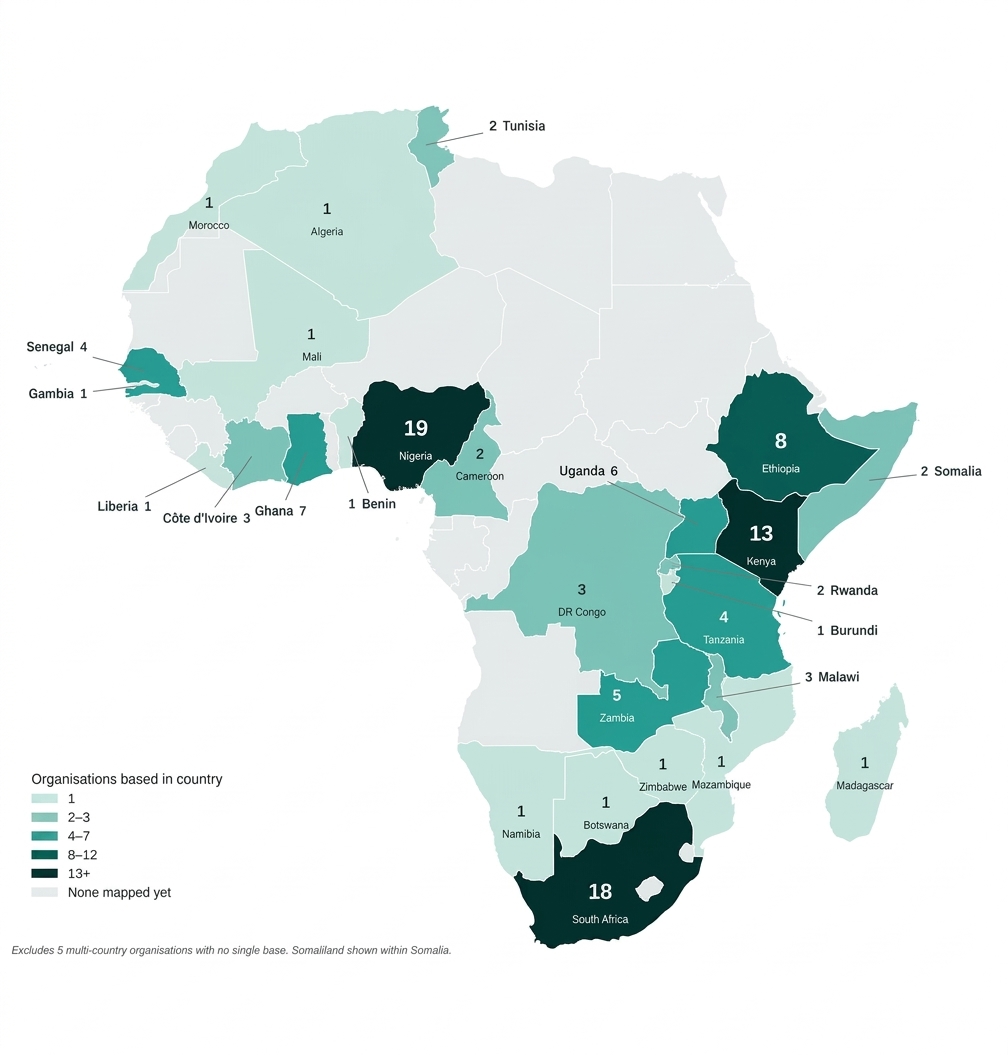
Health modelling organisations mapped in Phase 1, by country (as of 23 November 2026).
A few patterns stand out:
• Activity is concentrated in a few hubs. Nigeria (19), South Africa (18) and Kenya (13) account for over 40% of the organisations mapped. Coverage of Central and North Africa is still thin.
• Universities are the backbone. Academic institutions make up about 40% of the list, followed by research institutes and multi-partner networks and consortia.
• Many work across borders. Nearly half operate beyond a single country, including 29 with a Pan-African reach.
• Infectious diseases and malaria lead. These are the most common focus areas, followed by TB and HIV. Climate and health, NCDs, and women's and maternal health are emerging but less represented.
• Methods are mostly classic. Mathematical and epidemiological modelling dominate. AI, machine learning and spatial approaches are still rare.
The mapping also shows what we don't yet know. This is where you come in.
Are you on the map? Help us complete it
This is a first draft of the landscape, and we know it is incomplete. We want to hear from you if:
• You are a modelling institution, consortium, network or initiative working in Africa that we haven't yet reached, or
• Your organisation is already on the list, and you would like to confirm or update your details.
Add or confirm your institution here: Modelling for Health in Africa (ModHA) - Mapping – Fill out form
Every entry helps funders, governments and partners find African modelling expertise, and helps modellers find each other.
What comes next
Your input will feed directly into Phase 2. In that phase, we will validate and expand the mapping through outreach to partners, networks and institutions, filling the gaps Phase 1 revealed.
The goal is a modelling community that is African-led, visible, well connected and able to shape health policy on the continent.
Modelling for Health in Africa (ModHA) is hosted by the Science for Africa Foundation and supported by the Gates Foundation and Wellcome.