Media Centre
Open Research proposals adopted in East Africa’s AI declaration
Thursday, April 2, 2026
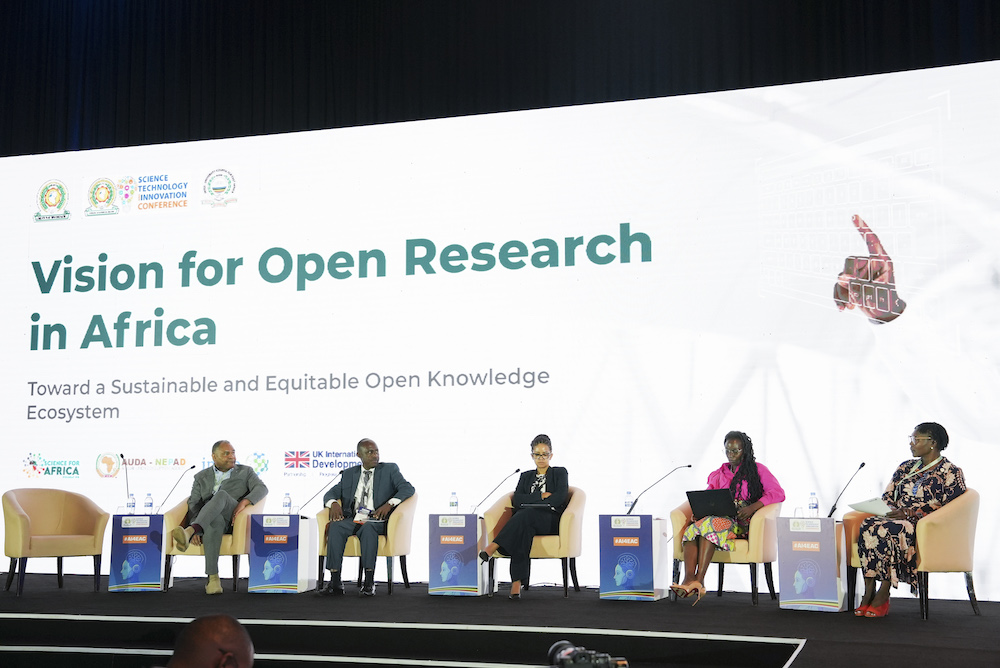
Kigali, Rwanda – April 2, 2026: Efforts to strengthen open research systems in Africa have received a major boost, with the formal adoption of the EAC Declaration on Artificial Intelligence.
In a landmark move, the declaration integrates key proposals from a high-level side event at the 4th EAC Regional Science, Technology and Innovation conference. This marks a significant step in the continent’s innovation agenda, calling for the reform of AI research ecosystems through open science, interdisciplinary collaboration and the integration of indigenous knowledge.
The outcome builds on a strategic session co-convened by African Union Development Agency (AUDA-NEPAD) and the Science for Africa Foundation (SFA Foundation), which brought together policymakers, researchers, and funders to advance an African-led Vision for Open Research, aligned with Agenda 2063 and the Science, Technology and Innovation Strategy for Africa (STISA 2034).
“Open research must be designed with Africa’s realities in mind,” said Mrs. Mahlet Teshome Kebede, Principal Policy Officer for Science and Technology at the African Union Commission. “Without this, we risk building systems that are open but not necessarily useful for our development priorities.”
While the broader conference spotlighted artificial intelligence as a driver of economic transformation, discussions at the side event underscored that AI ambitions will depend on stronger research systems - particularly those that enable data sharing, collaboration, and equitable access to knowledge.
Despite growing investments, translating research into deployable solutions remains a challenge due to persistent gaps in coordination, infrastructure, and financing. Overcoming these barriers requires collective ownership and a coordinated strategy focused on policy harmonization, sustainable financing, and the development of an interoperable digital infrastructure.
“Open research goes beyond access. It is about building an ecosystem where knowledge is created, shared, and applied to solve African challenges,” said Prof. Brando Okolo, Head of Science, Technology and Innovation at AUDA-NEPAD. “We must ensure that this ecosystem includes the private sector and informal systems, which are critical to innovation on the continent.”
A central focus of the session was the presentation of a draft Vision for Open Research in Africa, developed through a consultative process led by AUDA-NEPAD, SFA Foundation and partners. The vision outlines a future where, by 2034, Africa will have an African-led, globally influential open research ecosystem in which knowledge is openly created, accessible, and reusable to drive equitable development.
“This vision is about moving from fragmented efforts to a shared continental direction,” said Allen Mukhwana, Head of Programmes, Strengthening Science Ecosystems, SFA Foundation “It provides a foundation for aligning policy, infrastructure, and investment toward a system that works for Africa.”
The convening resulted in three key outcomes: a shared continental vision for open research, identified entry points for implementation, and a growing coalition of stakeholders committed to co-creating and operationalising this agenda.
“Our role is to support this transition by enabling dialogue, strengthening coordination, and helping translate ideas into actionable pathways,” said Dr. Moses Alobo, Head of Programmes, SFA Foundation. “Open research is not an end in itself - it is a means to accelerate science-to-impact across the continent.”
The inclusion of open research priorities in the EAC AI Declaration signals growing recognition that open, inclusive, and well-governed research systems are foundational to Africa’s digital and innovation ambitions.
Event images can be found here
Media Contact: Charles M. Njagi | [email protected]
Notes to Editors
About the African Union Development Agency
The African Union Development Agency (AUDA-NEPAD) is the African Union’s technical agency for implementing Agenda 2063, Africa’s blueprint for inclusive growth and sustainable development. It works with Member States and Regional Economic Communities to strengthen capacity, coordinate programmes, and advance knowledge-driven solutions across key sectors, including science, technology and innovation. AUDA-NEPAD plays a catalytic role in fostering partnerships, mobilising resources, and accelerating Africa’s transformation.
About the Science for Africa Foundation
The Science for Africa Foundation (SFA Foundation) is a pan-African, non-profit, and public charity organisation that supports, strengthens, and promotes science and innovation in Africa. The SFA Foundation serves the African research ecosystem by funding excellent ideas in research and innovation, enabling interdisciplinary collaborations, and building and reinforcing environments that are conducive for scientists to thrive and produce quality research that generates new, locally relevant knowledge.