Media Centre
Calestous Juma Fellows call for research and development reforms to deliver on STISA 2034 ambitions
Friday, February 13, 2026
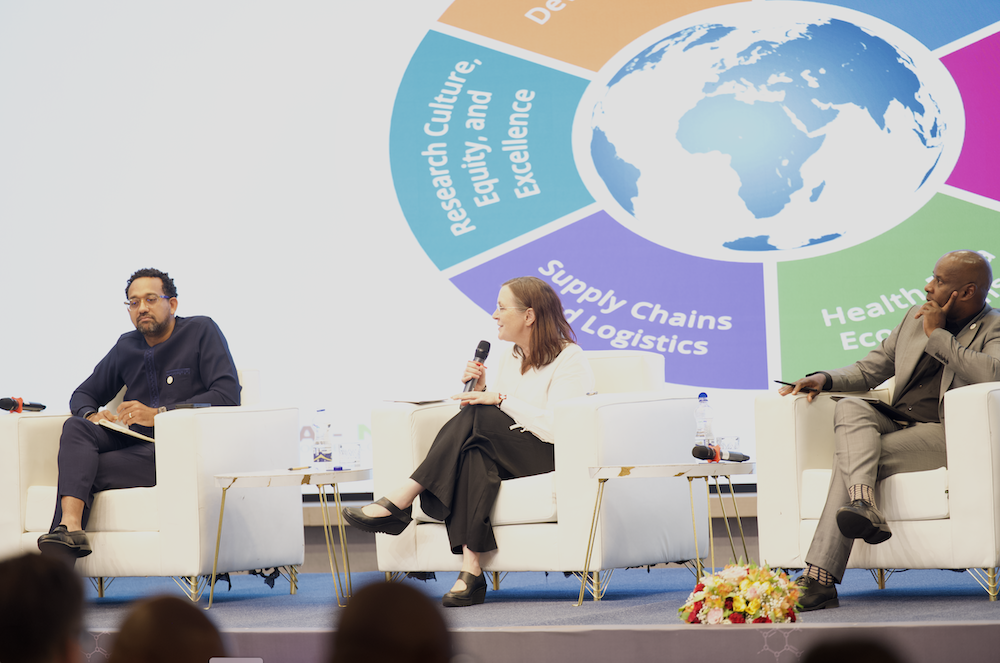
On the sidelines of the African Union Summit in Addis Ababa, the Calestous Juma Science Leadership Fellows (CJ Fellows) convened an elevated dialogue session on February 11, 2026, to address a critical regional issue. Africa is producing world-class research, but too little of it is being translated into usable innovation, competitive industries, and large-scale development gains. Transformation remains the missing link in Africa’s research journey.
The SFA Foundation and the African Union Development Agency (AUDA-NEPAD) convened the baraza during Science, Technology and Innovation Week. Held under the theme “Translating Evidence into Action: Actionable Approaches to Empower African Research & Development,” the meeting focused on turning research into real-world results. It brought together a diverse group of leaders and partners, including African health ministers, government policymakers, researchers, development partners, private sector representatives, and members of the media.
Setting the scene, Dr Moses Alobo, Head of programmes, Science Innovation and Entrepreneurship (SITE) at SFA Foundation, noted that Africa’s scientific potential depends on the strength of the systems behind it, and that research must be treated as a strategic economic investment if it is to improve lives. "Africa is not short of ideas or talent. What we often lack are enabling policy environments that allow research to prosper and be translated into impact,” Dr Moses said.
AUDA-NEPAD leadership emphasised the importance of practical, context-responsive solutions that enable African Union Member States to strengthen innovation systems and build competitive industries in line with the goals of Agenda 2063
The dialogue came alive through a candid experience-driven exchange among the CJ Fellows. Prof. Nicki Tiffin , Professor and Deputy Director at the South African National Bioinformatics Institute at the University of the Western Cape, drew on her experience navigating research infrastructure, data systems, and policy environments that shape scientific competitiveness. From Ghana, Dr Yaw Bediako, CEO of Yemaachi Biotech and Dean of Research and Innovation at Ashesi University, brought an entrepreneurial lens, highlighting the practical realities of building African biotech companies within existing financing and regulatory ecosystems. Rounding out the panel, Dr Vincent Okungu , Senior Researcher and Health Economist at the University of Nairobi, grounded the discussion in the economics of health systems, workforce productivity, and long-term national development.
Moderated by Georgie Ndirangu of the Africa Leadership and Dialogue Institute, the discussion was dynamic, solutions-focused, and grounded in shared accountability. Across their different disciplines, the Fellows converged on a clear conclusion: Africa’s research ecosystem is not constrained by a lack of talent but by structural barriers—including financing gaps, weak development pipelines, policy bottlenecks, and limited private sector participation.
Building on this, the discussion surfaced several interlinked structural constraints that continue to limit Africa’s Research and Development (R&D) competitiveness.
R&D financing remains low and fragmented, with many African countries investing only about 0.3–0.4% of GDP, far below the 1% benchmark. While increasing public funding is essential, the panel emphasised that globally competitive R&D ecosystems are built when private sector investment plays a leading role, supported by government incentives and risk-sharing mechanisms.
At the same time, the development component of R&D remains weak. Africa produces strong research, but capacity gaps persist in product development, regulatory strategy, market entry, iteration, and risk capital. Too many research projects still end at publication, without clear pathways to enterprise creation or scaled delivery.
Policy environments can further increase the cost of innovation. Professor Tiffin shared examples of institutions receiving donated scientific equipment but still facing high import taxes and duties - costs that can delay research progress and weaken institutional competitiveness. The Fellows stressed the need to treat research infrastructure as a strategic national asset rather than a taxable luxury.
Talent retention also remains under pressure. Weak incentives, short-term academic contracts, and limited career stability continue to push skilled researchers out of the continent. Product-driven enterprises and stronger innovation ecosystems were highlighted as critical to retaining talent, building institutional memory, and enabling meaningful diaspora engagement.
Dr Vincent Okungu, reinforced the economic case for investment in research - particularly in health. He described health R&D not as a cost, but as long-term economic infrastructure. Sustained investment in locally led innovation strengthens health systems, supports workforce productivity, and reduces reliance on imported technologies. He urged governments and partners to move away from fragmented, short-term funding toward predictable, long-term financing models capable of supporting programme continuity and product development in areas of high disease burden.
Rather than stopping at diagnosis, the discussion also advanced practical reforms that governments and partners can implement in the near term. These included establishing national R&D priority frameworks aligned to economic outcomes; creating public–private derisking mechanisms to crowd in investment; introducing fiscal and regulatory incentives to reduce the cost of innovation, including duty exemptions for research equipment; developing R&D transparency dashboards to track investment and outcomes; institutionalising translation pathways linking universities to industry; and strengthening structured diaspora investment and collaboration mechanisms.
Together, these actions point to a clear shift in focus. Africa is not short on ideas or talent. The challenge now is financing, governing, and scaling innovation into solutions that deliver real economic and societal returns.
The next decade must be defined by execution. Governments, investors, and partners should rally around well-supported products that demonstrate clear returns, as these successes are what will shift market confidence and unlock sustained private capital. Ultimately, proving that African science generates long-term economic value is the only way to secure enduring investment and maintain our momentum.